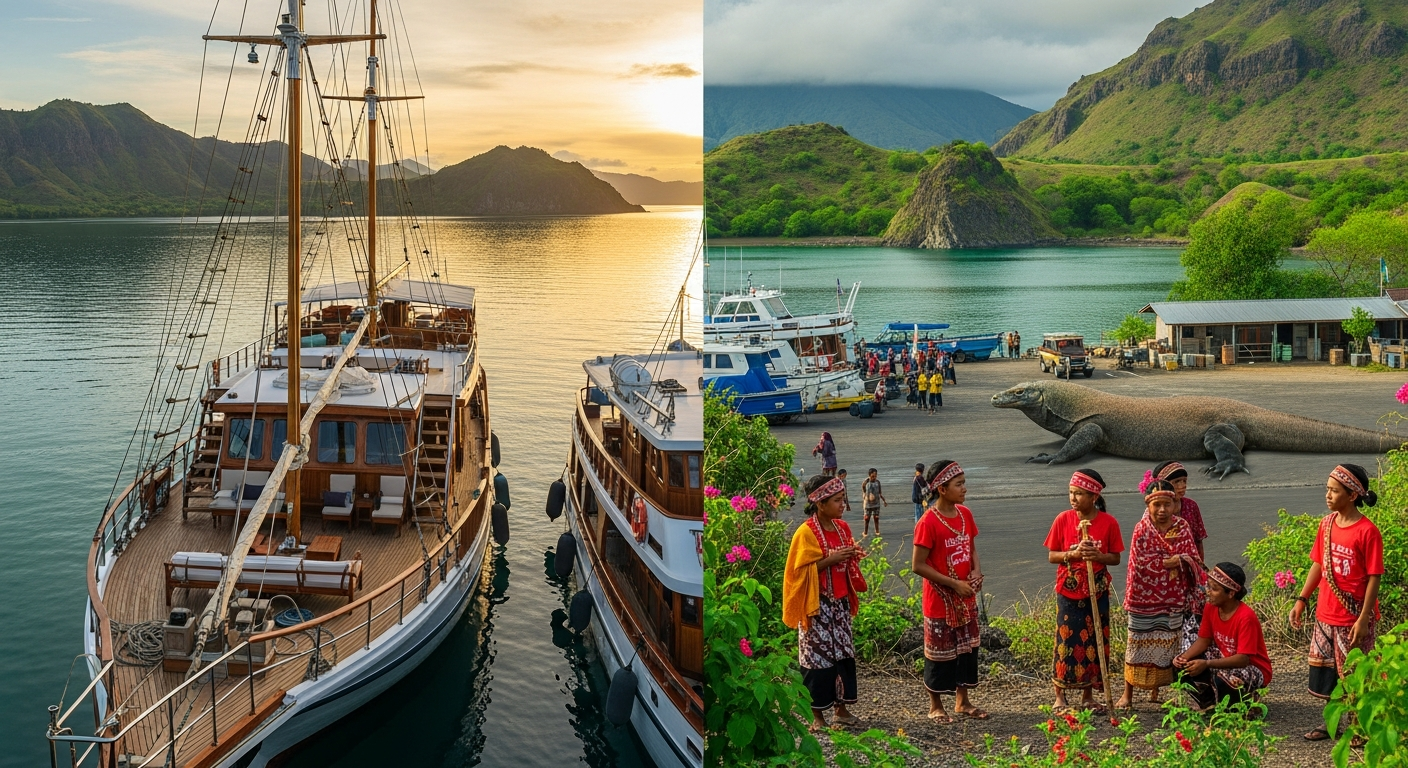
The morning light catches the mist over Komodo Airport’s runway, hinting at the vastness beyond Labuan Bajo. A warm breeze carries the scent of sea salt and distant frangipani. This is Flores, an island where every horizon promises a new discovery, a land waiting to unfold its authentic narratives.
Labuan Bajo: Western Gateway to Flores and Komodo’s Realm
Labuan Bajo, positioned at Flores’ westernmost tip, serves as the primary entry point for travelers arriving by air, specifically via Komodo Airport (LBJ). This bustling port town functions as the critical springboard for expeditions into the Komodo National Park, a UNESCO World Heritage Site since 1991. Visitors typically spend 2-3 days exploring the park’s iconic resident, the Komodo dragon (Varanus komodoensis), found on Komodo, Rinca, and Padar islands. The park itself spans over 1,733 square kilometers of marine and terrestrial ecosystems, established in 1980 to protect the world’s largest lizard. Beyond the dragons, the park offers some of the planet’s most biodiverse dive sites, including Batu Bolong and Manta Point, where manta rays with wingspans reaching 7 meters glide through nutrient-rich waters. Daily boat departures from Labuan Bajo facilitate these explorations, ranging from compact speedboats to luxurious liveaboards.
Back on Flores, Labuan Bajo itself provides a vibrant introduction to island life. The town’s fish market teems with fresh catches each evening, a spectrum of tuna, snapper, and squid, often grilled on the spot. Accommodation options range from boutique hotels to luxury resorts, many offering panoramic views of the Flores Sea. The local economy thrives on tourism, with an estimated 250,000 visitors passing through annually before 2020. The journey from Labuan Bajo eastward into Flores’ interior immediately shifts the landscape from coastal vibrancy to rugged, verdant hills. The Trans-Flores Highway, while undergoing upgrades, remains the vital artery connecting the island’s diverse regions, offering a road trip experience unlike any other in Indonesia. Consider a private vehicle for optimal comfort, covering distances like the 160-kilometer stretch to Ruteng in approximately 4-5 hours, depending on road conditions. For those extending their Komodo adventure, Flores Island Tour provides seamless transitions from your liveaboard dock to your awaiting private transfer, ensuring continuity in your luxury travel experience. Discover more about our Komodo National Park extensions here.
Kelimutu’s Chromatic Lakes and Central Flores Wonders
Journeying eastward from Labuan Bajo, the landscape transforms, leading towards Ende and the iconic Kelimutu National Park. Perched at an elevation of 1,639 meters above sea level, Mount Kelimutu hosts three volcanic crater lakes, each possessing a distinct and unpredictably shifting color. Tiwu Ata Bupu (Lake of Old People) typically appears blue, while Tiwu Ko’o Fai Nuwa Muri (Lake of Young Men and Maidens) and Tiwu Ata Polo (Enchanted Lake) have been observed in shades of green, red, brown, black, and white. These color changes are attributed to varying mineral content and gas activity within the volcanic vents, a phenomenon observed for centuries by the indigenous Lio people. Local mythology attributes spiritual significance to each lake, believing them to be resting places for departed souls, with colors reflecting their mood or fate. The best time for viewing is typically at sunrise, requiring an early start from Moni, a small village located just 12 kilometers (approximately 30 minutes drive) from the crater rim.
The drive to Kelimutu from Ende takes roughly 1.5 hours, covering 50 kilometers of winding roads. Ende itself holds historical significance as the place where Indonesia’s first president, Sukarno, was exiled by the Dutch from 1934 to 1938. His former residence, now a museum, offers insight into his formative years and the Pancasila philosophy he developed. Near Kelimutu, the Wolobobo viewpoint provides panoramic vistas of the surrounding volcanic landscape and the city of Ende below. This area, rich in Lio culture, offers opportunities to witness traditional ikat weaving, a complex craft where threads are resist-dyed before weaving, creating intricate patterns unique to each village. A high-quality, hand-woven Lio ikat textile can take months to produce and fetch prices upwards of 5,000,000 IDR. Flores Island Tour customizes itineraries to include visits to local weaving cooperatives, allowing direct engagement with artisans and supporting sustainable cultural practices. The journey through Central Flores reveals a rhythm of life deeply connected to the land and its ancient traditions.
Bajawa and Ngada Highlands: Cultural Depths and Megalithic Heritage
Continuing the journey through Flores, the Bajawa region emerges as a cultural heartland, home to the Ngada people and their remarkably preserved megalithic villages. Bena, arguably the most renowned, is a traditional village built on a hillside, characterized by its stone altars (ngadhu) and ancestral shrines (bhaga) that stand as testaments to animist beliefs. These structures, often adorned with buffalo horns and pig jawbones, represent male and female ancestors, respectively. The village itself dates back centuries, with its oldest structures estimated to be over 1,000 years old. Bena is located approximately 19 kilometers (a 45-minute drive) south of Bajawa town. Another significant village, Luba, lies just a few kilometers from Bena, offering a similar, yet distinct, architectural and cultural experience. Visitors are often welcomed into the community, observing daily life, which includes coffee processing, weaving, and communal rituals.
The Ngada highlands are also famous for their robust Arabica coffee, grown at elevations between 1,200 and 1,700 meters. The volcanic soil of Mount Inerie, an active stratovolcano reaching 2,245 meters, contributes to the coffee’s distinctive flavor profile. The region’s cultural calendar is marked by various ceremonies, including the impressive Caci, a ritual whip fight performed by Manggarai men, often during harvest festivals or important community gatherings. While originating from Manggarai, its influence extends to Ngada. Participants, dressed in traditional attire, engage in a dance-like duel, symbolizing bravery and community spirit. Flores Island Tour can arrange viewings of these performances, subject to local schedules and availability. The Bajawa area offers cooler temperatures compared to the coast, with average daytime temperatures around 20-25°C. For those seeking authentic cultural immersion, the Ngada highlands present an unparalleled opportunity to connect with ancient traditions and witness a way of life that remains deeply rooted in ancestral customs. Learn more about Flores cultural tours and their intricate details.
Wae Rebo: A UNESCO Village Journey into Isolation
The journey to Wae Rebo village represents one of Flores’ most immersive and rewarding experiences, a testament to the island’s enduring traditional architecture and community spirit. Located in a remote valley of the Manggarai highlands, Wae Rebo is a traditional village recognized on UNESCO’s Tentative List for World Heritage status. Its iconic seven conical Mbaru Niang houses, each standing up to 15 meters tall, are distinct for their unique architecture: a central pole supporting five levels, each with a specific function, from sleeping quarters to food storage and ceremonial space. These houses are built from local materials—wood, bamboo, and lontar palm leaves for roofing—and are meticulously maintained by the community. The village is approximately 110 kilometers from Labuan Bajo, requiring a drive of about 3-4 hours to the trailhead at Denge, followed by a challenging but rewarding trek.
The hike from Denge to Wae Rebo typically takes 2.5 to 3 hours, covering a distance of approximately 7 kilometers with an elevation gain of around 700 meters. The path winds through dense tropical rainforest, offering glimpses of diverse flora and fauna. Upon arrival, visitors undergo a traditional welcome ceremony (wela lu’u) in the main Mbaru Niang, a gesture of respect and acceptance by the village elders. This ritual, often accompanied by offering a small donation, is essential for a respectful visit. The community of Wae Rebo, numbering around 1,200 people, sustains itself primarily through agriculture, cultivating coffee, vanilla, and spices. Staying overnight in a designated Mbaru Niang is an integral part of the experience, providing a deeper connection to the village’s rhythm and allowing for stargazing away from light pollution. Facilities are basic but clean, offering a genuine glimpse into their daily lives. Flores Island Tour facilitates this journey with experienced local guides, ensuring a respectful and insightful cultural exchange. The isolation of Wae Rebo, maintained by its challenging access, preserves a way of life that has remained largely unchanged for centuries, offering a profound contrast to the modern world.
Riung 17 Islands Marine Park and Eastern Flores Charms
Venturing further east along the Flores coastline brings travelers to Riung, the gateway to the Riung 17 Islands Marine Park. Despite its name, the park actually encompasses more than 20 islands, islets, and rocks, spread across approximately 17,000 hectares. Established in 1996, this marine protected area is a sanctuary for diverse coral reefs, vibrant fish species, and significant populations of flying foxes (fruit bats). Daily boat trips depart from Riung, exploring islands such as Pulau Ontoloe, known for its mangrove forests teeming with thousands of flying foxes visible during daylight, and Pulau Rutong, which boasts pristine white sand beaches and excellent snorkeling opportunities. The calm, clear waters make it an ideal location for swimming and discovering colorful marine life, including clownfish, reef sharks, and various hard and soft corals. A typical island-hopping tour includes a fresh seafood lunch prepared by local boat captains on one of the deserted beaches.
East of Riung, the town of Maumere serves as another significant entry point to Flores, with Frans Seda Airport (MOF) connecting to major Indonesian cities. Maumere Bay is recognized for its impressive coral gardens, particularly after the 1992 earthquake and tsunami, which ironically helped rejuvenate certain reef areas. Diving and snorkeling here reveal a resilience and diversity that attracts marine enthusiasts. Further east, Larantuka, often referred to as the “City of the Queen of the Rosary,” offers a unique blend of Catholic and traditional culture. Its annual Semana Santa (Holy Week) procession, influenced by Portuguese colonial heritage dating back to the 16th century, is a profound religious event, drawing thousands of pilgrims. The procession involves carrying statues of the Virgin Mary (Tuan Ma) and Jesus Christ (Tuan Ana) through the town, culminating in a sea procession. This vibrant display of faith showcases Flores’ historical ties to European Catholicism. The journey through Eastern Flores provides a deeper understanding of the island’s diverse landscapes, from its pristine marine parks to its deeply spiritual communities, a contrast that enriches any comprehensive Flores Island tour.
Planning Your Flores Island Tour: Logistics and Tailored Luxury
Designing a comprehensive Flores Island tour requires careful consideration of logistics, given the island’s expansive geography and varied attractions. Most premium itineraries begin in Labuan Bajo, leveraging its international airport (LBJ) and status as the Komodo gateway. From there, the journey typically progresses eastward along the Trans-Flores Highway, connecting key destinations like Ruteng, Bajawa, Moni (for Kelimutu), Ende, and Maumere. A typical full Flores exploration, covering these highlights including Wae Rebo, spans 7 to 10 days to allow for comfortable travel times and in-depth cultural engagement. For instance, the drive from Labuan Bajo to Bajawa can take 6-8 hours, while Bajawa to Moni is another 4-5 hours. Our premium tours prioritize comfort and efficiency, utilizing well-maintained private vehicles and experienced local drivers who navigate the island’s roads with expertise. We ensure transparent pricing, detailing what is included—such as private transfers, accommodation in hand-picked boutique hotels or eco-lodges, expert local guides, entrance fees to national parks and villages, and specific cultural activities—and what is excluded, like international flights or personal expenses. This clarity empowers you to make informed decisions about your investment.
Accommodation options across Flores have evolved significantly, offering choices from charming guesthouses in traditional villages to luxury eco-resorts with ocean views. In Labuan Bajo, properties like Ayana Komodo Resort or Sudamala Resort offer five-star amenities. In more remote areas like Moni or Bajawa, boutique hotels provide comfort alongside authentic local ambiance. Our selection process focuses on properties that combine comfort, service, and a commitment to sustainable tourism practices. We also integrate opportunities for direct community engagement, from participating in coffee harvesting demonstrations to observing traditional ikat weaving, ensuring your journey contributes positively to local economies. Trust signals are paramount: our guides possess certifications in first aid and local cultural knowledge, and our vehicles adhere to stringent safety standards. Compared to generic package tours, Flores Island Tour specializes in bespoke itineraries, crafting each journey to align with your specific interests, whether they lean towards photography, cultural anthropology, or marine exploration. Frequently asked questions regarding packing (lightweight clothing, sturdy walking shoes, sun protection), currency (Indonesian Rupiah – IDR), and connectivity (limited Wi-Fi in remote areas) are addressed proactively in your pre-departure briefing. We offer 24/7 support throughout your journey, ensuring peace of mind. For a truly personalized and authentic exploration of this remarkable island, consider a Flores Island tour tailored to your exact preferences.
The call of Flores is distinct—a symphony of ancient traditions, volcanic landscapes, and vibrant marine life. Let Flores Island Tour arrange your bespoke journey, connecting you with the authentic heart of this Indonesian jewel. Explore our customizable itineraries and begin planning your extraordinary adventure today. Inquire about your premium Flores Island tour and discover the unparalleled beauty and culture that awaits.