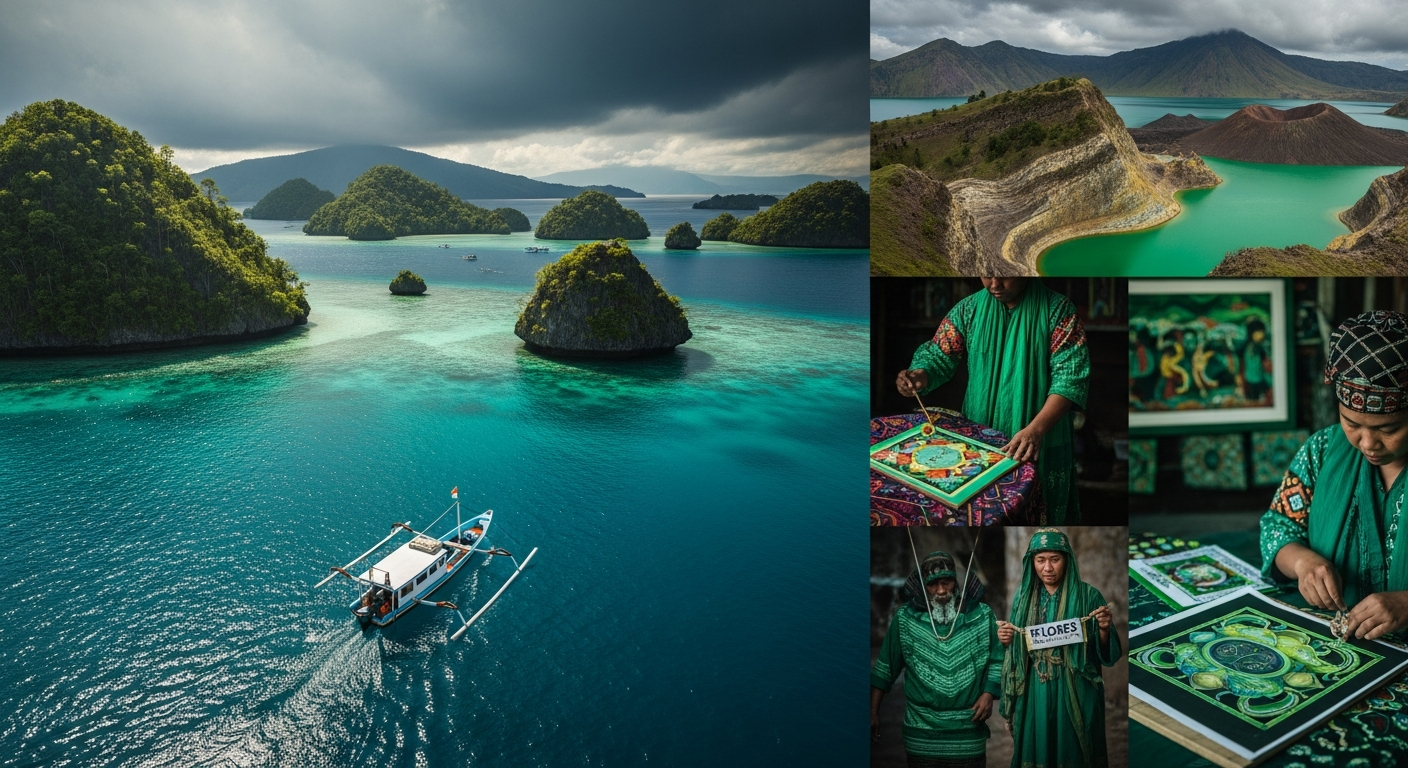
A Flores Island tour navigates the diverse landscapes and cultures of East Nusa Tenggara, extending beyond Komodo National Park. It typically encompasses overland travel from Labuan Bajo to destinations like Kelimutu’s tricolor lakes, traditional Ngada villages, and the Wae Rebo UNESCO site. Journeys often span 5 to 10 days, allowing for deep engagement with Manggarai, Ngada, and Lio traditions.
- Explore ancient Ngada villages such as Bena, observing megalithic structures.
- Witness the dynamic Caci stick fight, a Manggarai ritual dance.
- Ascend to Kelimutu, experiencing its three distinctively colored crater lakes.
The scent of volcanic earth mixes with the distant sound of ocean waves; Flores presents an island journey where every vista shifts, every encounter deepens. Here, the landscape itself tells stories, from ancient rituals to vibrant natural phenomena.
Planning Your Flores Island Tour: Scope and Customization
A comprehensive flores island tour unravels the island’s intricate narrative, commencing often from Labuan Bajo, the western gateway, and extending eastward. Travelers typically traverse the Trans-Flores Highway, a 670-kilometer stretch connecting key cultural and natural sites. The experience is not merely a transit; it is a progression through distinct cultural zones and ecological wonders. A standard itinerary often spans 5 to 10 days, allowing for a balanced exploration of its varied regions, from the Manggarai regency in the west to the Lio heartland in the center and the distant reaches of Larantuka in the east. This duration permits visits to multiple traditional villages and natural parks without feeling rushed, ensuring genuine interaction with local communities. For instance, a 7-day tour might include two nights in Labuan Bajo, one night near Ruteng, two nights in Bajawa, and two nights in Moni near Kelimutu, before concluding in Ende or Maumere.
Q: What defines a typical Flores Island Tour experience?
A: A typical Flores Island tour offers a multi-faceted exploration, moving beyond the well-known Komodo dragons to reveal the island’s rich interior. The journey generally begins in Labuan Bajo, a bustling port town and the primary entry point for travelers arriving via Komodo flights. From here, expeditions extend overland, often west to east, to destinations like the traditional Manggarai village of Wae Rebo, a UNESCO World Heritage site, accessible by a 3-hour trek from Denge village. Further east, the tour introduces the Ngada highlands around Bajawa, where ancestral villages like Bena and Luba feature megalithic stones and traditional thatched-roof houses. The final major highlight often includes the surreal, ever-changing colors of Kelimutu’s three crater lakes near Moni, a natural spectacle at an altitude of 1,639 meters. Each stop provides a unique perspective on Flores’ diverse ecosystems and the distinct cultures of its various ethnic groups, including the Manggarai, Ngada, and Lio people. The experience emphasizes cultural exchange, often involving homestays or interactions with local artisans.
Q: Can I customize my Flores Island tour itinerary?
A: Yes, the design of a flores island tour is highly flexible, adapting to individual preferences and travel styles. Whether your focus leans toward intensive trekking, deep cultural immersion, or marine activities, itineraries can be precisely tailored. For those with specific interests, options range from extended stays in Ngada villages to participate in local ceremonies, to dedicated photography expeditions targeting Kelimutu at sunrise. Travelers seeking adventure might incorporate additional hikes to waterfalls such as Tutubhada or explore the remote Riung 17 Islands Marine Park, a collection of uninhabited islets offering exceptional snorkeling and birdwatching opportunities. Our consultants work directly with you to craft a personalized route, considering factors like desired pace, accommodation preferences (from boutique hotels to authentic homestays), and specific sites of interest. This ensures your journey aligns perfectly with your vision for exploring Flores, whether it’s a 3-day cultural sprint or a leisurely 12-day discovery of its every corner. For more information on custom options, visit our homepage.
Booking and Pricing for Your Flores Island Tour
Understanding the financial aspects of a flores island tour involves several key variables. Pricing reflects the depth and exclusivity of the experience, accounting for factors such as the duration of the journey, the standard of accommodation selected, and the mode of transportation. Private tours with dedicated vehicles and professional guides naturally command a higher investment compared to shared group itineraries. A typical 7-day private tour for two people might range from 1,500 USD to 3,500 USD, depending on luxury levels. This range includes airport transfers, all ground transportation, accommodation, specified meals, and entrance fees to national parks and cultural sites. The expertise of a local guide, fluent in both Bahasa Indonesia and English, significantly enhances the journey, offering insights into local customs and history that independent travel often misses. Transparent pricing ensures all inclusions are clearly outlined, preventing unexpected costs during your exploration of Flores. Early booking, especially for peak seasons (July-August and December-January), is recommended to secure preferred dates and accommodations.
Q: What are the primary factors influencing Flores Island tour pricing?
A: The cost of a flores island tour is primarily determined by its duration, the caliber of accommodation, and the type of transportation. A longer tour, such as an 11-day itinerary from Labuan Bajo to Maumere, naturally incurs higher costs than a 4-day segment focusing solely on the west. Accommodation choices range from budget-friendly guesthouses starting at 30 USD per night to luxury resorts in Labuan Bajo exceeding 200 USD per night. Transportation typically involves private air-conditioned vehicles with professional drivers, ensuring comfort and flexibility on the Trans-Flores Highway. Internal flights, for instance, from Labuan Bajo to Ende or Maumere, also contribute to the overall price. Furthermore, the inclusion of specialized activities like Komodo dragon trekking permits (approximately 25-35 USD per person), diving excursions around Labuan Bajo, or participation in traditional ceremonies like the Manggarai Caci stick fight, directly impacts the final quotation. Meals, guide services, and entrance fees to sites like Kelimutu National Park (around 10-15 USD for foreign visitors) are usually bundled into comprehensive packages, offering a seamless travel experience.
Q: How do I book a Flores Island tour and what payment methods are accepted?
A: Booking your flores island tour is a straightforward process, beginning with an inquiry through our website or direct consultation with our travel specialists. After discussing your interests and preferences, a detailed itinerary and quotation are provided. Upon your approval, a deposit, typically 30% of the total tour cost, is required to confirm reservations for flights, accommodations, and private transport. The remaining balance is generally due 30 days prior to your arrival in Flores. We accept various payment methods for your convenience, including secure bank transfers to our Indonesian account and major credit cards (Visa, MasterCard), though a processing fee of 2-3% may apply for card transactions. All financial transactions are processed securely, adhering to international standards. Upon receipt of your deposit, you receive a confirmation package detailing your itinerary, booking references, and essential pre-departure information. Our team remains available to answer any questions leading up to your departure, ensuring a smooth and confident start to your Flores adventure. Learn more about our booking process on our Flores Island Tour page.
Ensuring Safety and Comfort on Flores Island
Safety and comfort remain paramount during any flores island tour. We prioritize the well-being of our guests by employing licensed, experienced local guides and professional drivers who possess extensive knowledge of Flores’ terrain and cultural nuances. All vehicles are regularly maintained and equipped with necessary safety features, ensuring reliable transport across varying road conditions, particularly on the winding Trans-Flores Highway. Emergency protocols are in place, and guides are trained in first aid, providing a layer of security throughout your journey. For health considerations, it is advisable to consult your physician regarding recommended vaccinations for Indonesia. While specific vaccinations are not typically mandatory for Flores, general travel health advice includes staying hydrated, using insect repellent, and consuming bottled water. Travel insurance covering medical emergencies and trip cancellations is highly recommended for all visitors. This proactive approach allows you to focus entirely on the discoveries and interactions that define the Flores experience, from the vibrant markets of Ende to the serene landscapes of Wolobobo viewpoint, without undue concern.
Q: What safety precautions are in place for Flores Island tours?
A: For every flores island tour, stringent safety measures are implemented. Our tour operators collaborate with certified local guides who are not only bilingual but also trained in emergency response and local safety protocols. Drivers are selected for their experience navigating Flores’ roads, adhering to speed limits, and ensuring vehicle maintenance. All tour vehicles undergo regular inspections, equipped with seatbelts and first-aid kits. When undertaking activities like trekking to Wae Rebo or exploring Komodo National Park, guides provide detailed briefings on terrain, wildlife interactions, and necessary precautions. For marine activities in areas like Riung 17 Islands Marine Park, licensed boat operators and life jackets are standard. We also monitor local conditions, including weather patterns and community events, to adjust itineraries as needed, prioritizing guest safety above all. For instance, during the annual Larantuka Catholic procession, specific road closures might occur, which our team anticipates and plans around. The Indonesian National Board for Disaster Management (BNPB) provides regular updates on regional conditions, which we monitor closely. For general travel safety advice in Indonesia, refer to the Indonesia Travel website.
Q: What are the health and visa requirements for visiting Flores Island?
A: Travelers undertaking a flores island tour must adhere to standard Indonesian visa regulations. Many nationalities are eligible for a Visa on Arrival (VoA) or visa-free entry for short stays, typically up to 30 days. It is crucial to check the latest visa policies through the Indonesian Embassy in your country of residence or the Directorate General of Immigration website prior to travel. Regarding health, no specific vaccinations are legally required for entry into Indonesia, but routine vaccinations (e.g., Hepatitis A, Typhoid) are generally recommended. Malaria risk is present in some rural areas of Flores, so consulting a travel health specialist about antimalarial medication is advisable. Dengue fever is also endemic, making mosquito bite prevention essential. Access to medical facilities varies across Flores; Labuan Bajo and Ende have hospitals, but smaller towns offer limited services. We strongly recommend comprehensive travel insurance that covers medical emergencies, evacuation, and trip interruptions. Always carry personal medications and a basic first-aid kit. For official information on visa requirements, refer to Wikipedia’s Visa policy of Indonesia.
Beyond Komodo: Exploring Flores’ Cultural Depth
While Komodo National Park draws many to Flores, the island’s true essence lies in its vibrant cultural landscapes, far beyond the dragon’s realm. A flores island tour offers profound encounters with the distinct traditions of the Manggarai, Ngada, and Lio ethnic groups. In the western Manggarai regency, visitors witness the Caci stick fight, a ritualistic whip-fighting dance accompanied by drumming and chanting, often performed during harvest festivals or important communal events. This martial art is a deep cultural expression of courage and community spirit. Moving eastward to the Ngada highlands around Bajawa, ancient megalithic villages like Bena and Luba stand as living museums. Here, conical thatched-roof houses (sa’o) flank ancestral shrines (ngadhu and bhaga), symbolizing male and female ancestors, respectively. These structures, some over 1,000 years old, are meticulously maintained, preserving a profound connection to the past. Further still, in the central Lio region near Ende and Moni, the intricate process of ikat weaving showcases exceptional artistry, where complex patterns are dyed and woven by hand, reflecting local myths and natural motifs. These cultural layers provide a rich context to the island’s diverse natural beauty.
Q: What cultural experiences await visitors beyond the major landmarks?
A: Beyond the well-trodden paths to Komodo and Kelimutu, a flores island tour unlocks a spectrum of authentic cultural experiences. In the Ngada region, a visit to traditional villages such as Gurusina, located about 20 kilometers south of Bajawa, offers an intimate look at local life. Here, you observe daily routines, participate in coffee ceremonies, and learn about the animistic beliefs intertwined with Catholic faith. The Manggarai regency provides opportunities to visit local markets, like Pasar Ruteng, where various spices, textiles, and agricultural products are traded, offering a sensory explosion of local commerce. Engaging with local artisans demonstrating the process of making sopi, a traditional palm liquor, or observing the intricate steps of ikat weaving in the Lio villages near Maumere, provides deeper insight into the island’s heritage. These interactions emphasize respect for local customs; a small donation or purchase of local crafts is often appreciated. The chance to witness a traditional Manggarai Caci stick fight, a powerful display of community and skill, is a truly immersive cultural event, often requiring specific timing for festivals.
Q: Are there alternatives to the standard overland Flores Island tour?
A: Yes, the concept of a flores island tour extends beyond the singular overland journey, offering specialized alternatives tailored to different timeframes and interests. For those with limited time or specific focus areas, regional tours are an excellent option. For example, a “Komodo Plus Wae Rebo” tour combines the iconic dragon encounters with a cultural trek to the UNESCO-listed traditional village, bypassing the full east-west traverse. Similarly, a “Kelimutu and Lio Culture” package focuses on the central Flores region, allowing for an in-depth exploration of Ende, Moni, and the surrounding ikat weaving communities. Fly-in/fly-out options are also available, where travelers fly directly to Ende or Maumere to access Kelimutu, then fly out from Labuan Bajo after a Komodo trip. For marine enthusiasts, liveaboard cruises from Labuan Bajo not only explore Komodo National Park but can also incorporate short land excursions to nearby Flores coastal villages. These alternatives provide flexibility, allowing you to design a journey that perfectly suits your schedule and specific desires for exploring Flores. Consider a focused Komodo National Park guide for extending your journey.
Unique Natural Wonders and Activities on Flores
Beyond its cultural heart, Flores reveals a landscape sculpted by volcanic activity and framed by rich marine ecosystems, offering a diverse palette of natural wonders. A flores island tour takes you to the surreal Kelimutu lakes, whose three crater lakes famously change color, from turquoise to dark red, then to black, due to varying mineral compositions and volcanic gas activity. This geological marvel, located near Moni, is best observed at sunrise, offering a truly ethereal experience. Further west, the Riung 17 Islands Marine Park presents an untouched aquatic playground. Despite its name, the park comprises over 20 islands and islets, providing exceptional snorkeling, diving, and opportunities to observe flying foxes (fruit bats) during their evening exodus. The volcanic highlands also host sites like Wolobobo, a viewpoint offering panoramic vistas of Bajawa and the surrounding active volcano, Inerie, which stands at 2,245 meters. For those seeking active engagement, trekking to Wae Rebo, a traditional conical-house village, involves a 3-hour hike through lush rainforest, culminating in a profound cultural reward. Each natural site on Flores offers a unique perspective, underscoring the island’s ecological diversity and geological dynamism. Visit UNESCO’s page on Wae Rebo for more information on its traditional architecture.
Q: What specific natural attractions are included in a Flores Island tour?
A: A typical flores island tour highlights several distinct natural attractions, showcasing the island’s geological and ecological diversity. The centerpiece for many is Kelimutu National Park, home to the three iconic crater lakes that mystify visitors with their unpredictable color changes. Located in the central part of the island, these lakes are a powerful symbol of Flores’ volcanic heritage. Further west, the Riung 17 Islands Marine Park, situated on the north coast, offers pristine coral reefs, white sand beaches, and a vibrant underwater world ideal for snorkeling and island hopping. The park is a sanctuary for various marine species and hosts thousands of flying foxes. In the Ngada region, the majestic Mount Inerie, an active stratovolcano, dominates the skyline, providing a dramatic backdrop to the traditional villages. Nearby, the Tutubhada waterfall, accessible via a short hike, offers a refreshing natural escape. The journey often includes scenic drives through rice paddies and past coffee plantations, particularly around Ruteng, revealing the island’s agricultural beauty. These natural sites are integrated into itineraries to provide a holistic view of Flores’ unique environment.
Q: How does a Flores Island tour cater to different travel styles, such as luxury or adventure?
A: A flores island tour is highly adaptable, designed to accommodate a spectrum of travel styles, from opulent luxury to rugged adventure. For luxury travelers, itineraries focus on exclusive experiences: private transfers in premium vehicles, stays in boutique hotels or eco-resorts with high-end amenities, and gourmet dining experiences featuring local and international cuisine. This might include a private yacht charter in Labuan Bajo for Komodo excursions or personalized cultural workshops. Adventure seekers, conversely, find itineraries emphasizing active pursuits: multi-day treks to remote villages like Wae Rebo, extensive snorkeling and diving trips in Riung or Komodo, and opportunities for homestays in traditional communities for an authentic cultural exchange. Budget-conscious travelers can opt for standard accommodations, public transport where feasible, and local eateries. Our consultants excel at tailoring each journey, ensuring that whether you seek five-star comfort or an off-the-be-grid expedition, your Flores Island tour aligns perfectly with your personal preferences and desired level of engagement. Explore options on our homepage.